Subtropical coastal humidity across coastal Palm Beach County creates rapid breeding cycles for container-breeding dipterans, demanding a targeted biological strategy rather than indiscriminate pesticide saturation.…
Subtropical coastal humidity across coastal Palm Beach County creates rapid breeding cycles for container-breeding dipterans, demanding a targeted biological strategy rather than indiscriminate pesticide saturation. Mosquito suppression relies on disrupting the insect lifecycle at both the aquatic instar phase and the adult resting phase. Water-retaining architectural features, bromeliads, and irrigation runoff common to historic properties in El Cid, Flamingo Park, and Grandview Heights trap stagnant pockets where female vectors deposit eggs. Unchecked standing reservoirs generate pupae within 7 to 10 days under South Florida ambient temperatures exceeding 80 degrees Fahrenheit. Rather than applying broad-spectrum toxins that disperse into local water channels, targeted biological active agents such as Bacillus thuringiensis israelensis and insect growth regulators are placed directly into catch basins, ornamental fountains, and saturated swales. This biological mechanism disrupts the cellular midgut of larvae without impacting non-target pollinators, ornamental fish, or domestic animals.
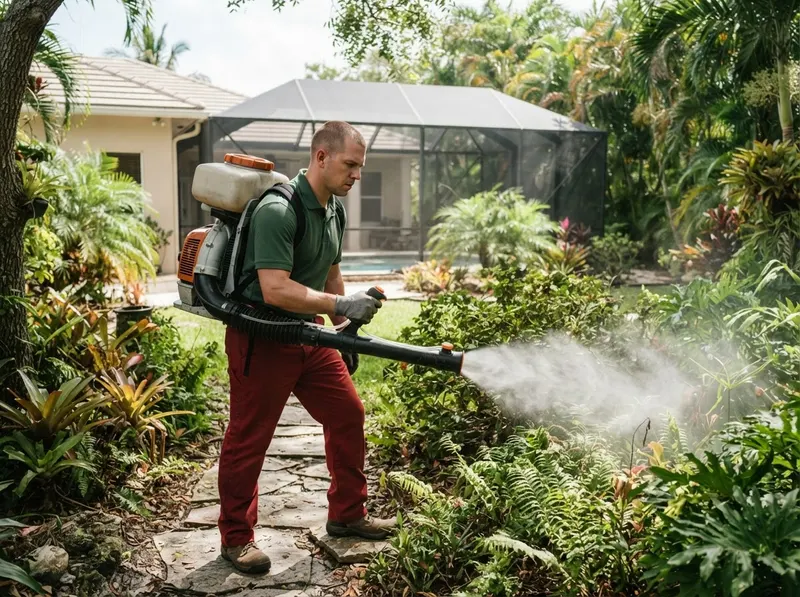
Adult suppression demands physical deposition of micro-emulsion droplets onto the undersides of dense botanical foliage where mosquitoes harbor during peak daylight hours. Properties in RiverWalk, the Villages of Palm Beach Lakes, and Northwood Village frequently feature dense areca palms, sea grapes, and ficus hedges that function as diurnal shelter zones. Motorized air-blast misting units deposit synthetic pyrethroids or biological alternatives certified under Florida Department of Agriculture and Consumer Services pesticide regulations. The droplet size is calibrated between 50 and 100 microns, ensuring adherence to the sub-surface of broadleaf vegetation without drift into non-target zones or public easements along Clematis Street and CityPlace. This micro-layer neutralizes adults upon contact and remains active for 21 to 30 days, creating a protective envelope around outdoor living spaces.
Decision guidance relies on evaluating property hydrology and surrounding vegetation mass. Properties bordering wetlands or preservation areas, such as residences adjacent to Grassy Waters Preserve or naturalized water hazards in Ibis Golf & Country Club, experience higher ambient vector influx. In these microclimates, stand-alone larvicide disks are insufficient because adult females migrate across property lines; a combined canopy misting barrier is necessary to deflect inbound populations. Conversely, zero-lot-line townhomes in CityPlace or SoSo (South of Southern) with sparse foliage require precision spot-treatment of planter basins, downspout extensions, and sub-surface french drains rather than extensive canopy misting. The trade-off between perimeter misting and automated misting systems centers on chemical volume and non-target exposure: scheduled manual applications reduce total synthetic load while maximizing barrier precision compared to unmonitored automated systems that discharge regardless of wind patterns.
Pre-treatment inspection maps hydrological vectors across every square foot of the parcel, cataloging bromeliad axils, clogged gutter lines, and air conditioning condensation discharges that feed subsurface moisture pockets near the Palm Beach Zoo & Conservation Society or Mounts Botanical Garden. Technical applications adhere strictly to standards issued by the Florida Department of Health, prioritizing vector abatement for known carriers of Eastern Equine Encephalitis. Equipment calibration follows protocols maintained by the Florida A&M Center for Public Health Entomology to track resistance patterns. Larval control materials leverage guidance from the American Mosquito Control Association and safety assessments coordinated with the University of Florida IFAS Extension. Environmental drift standards align with National Oceanic and Atmospheric Administration localized wind thresholds, ensuring treatments are deployed only during optimal barometric and meteorological windows. Technical oversight complies with federal guidelines administered by the United States Department of Agriculture for sub-tropical vector control. RedOak Pest Experts operates with licensed, dedicated structural biology specialists; field operations are managed internally without subcontractors. Direct inquiries and scheduling assessments are handled via telephone at (561) 216-1463.
Every job gets a firm, written price after a free on-site visit.
For standards, safe disposal, and service guidance on pest control services in West Palm Beach, FL, useful references include U.S. EPA, ENERGY STAR, U.S. Dept. of Energy, Consumer.gov, U.S. Census Bureau, and Google Maps. General consumer and small-business resources are available from USA.gov, Better Business Bureau, FTC Consumer Advice, U.S. Small Business Administration, and Ready.gov.
Tell us about your mosquito larvicide & canopy misting job in West Palm Beach and we'll send a clear, written quote, usually the same day.
 RedOak Pest Experts